

If you’ve ever sat in a therapist’s chair and been talked through grounding exercises, you’ll recognise the bones of this approach immediately. The 5-4-3-2-1 sleep method borrows a well-known anxiety management technique and reframes it as a way to ease yourself into sleep. It’s been circulating in wellness circles for a while now, and interest has picked up sharply as more people look for non-pharmaceutical ways to tackle the endless loop of thoughts that keep them awake at night.
The original 5-4-3-2-1 grounding technique was designed to pull people out of panic or dissociation by anchoring them in their immediate sensory environment. You identify five things you can see, four you can touch, three you can hear, two you can smell, and one you can taste. The sleep adaptation adjusts this for a horizontal, eyes-closed position and slows the whole process down considerably, turning it from a rapid grounding anchor into a slow, deliberate deceleration of the nervous system.
What’s actually happening in your brain when you do this?
The technique works on the principle of sensory engagement crowding out cognitive noise. When your brain is occupied processing genuine sensory input, whether that’s the weight of a duvet against your legs or the low hum of a fan, it has less bandwidth available for ruminative thought. This isn’t just anecdotal. Research into mindfulness-based interventions consistently shows that directed sensory attention lowers activity in the default mode network, the part of your brain most associated with mind-wandering, worry, and the kind of circular thinking that makes 11pm feel like the ideal time to mentally replay every awkward conversation you’ve had since 2009.
The NHS acknowledges that cognitive and relaxation techniques, including sensory grounding, are part of recommended approaches for managing anxiety and sleep difficulties. The NHS Every Mind Matters sleep hub includes breathing and mindfulness exercises as first-line self-help tools, which places the 5-4-3-2-1 sleep method firmly within evidence-adjacent territory, even if large-scale trials specifically on this exact protocol are still sparse.
How to actually do it as a sleep exercise
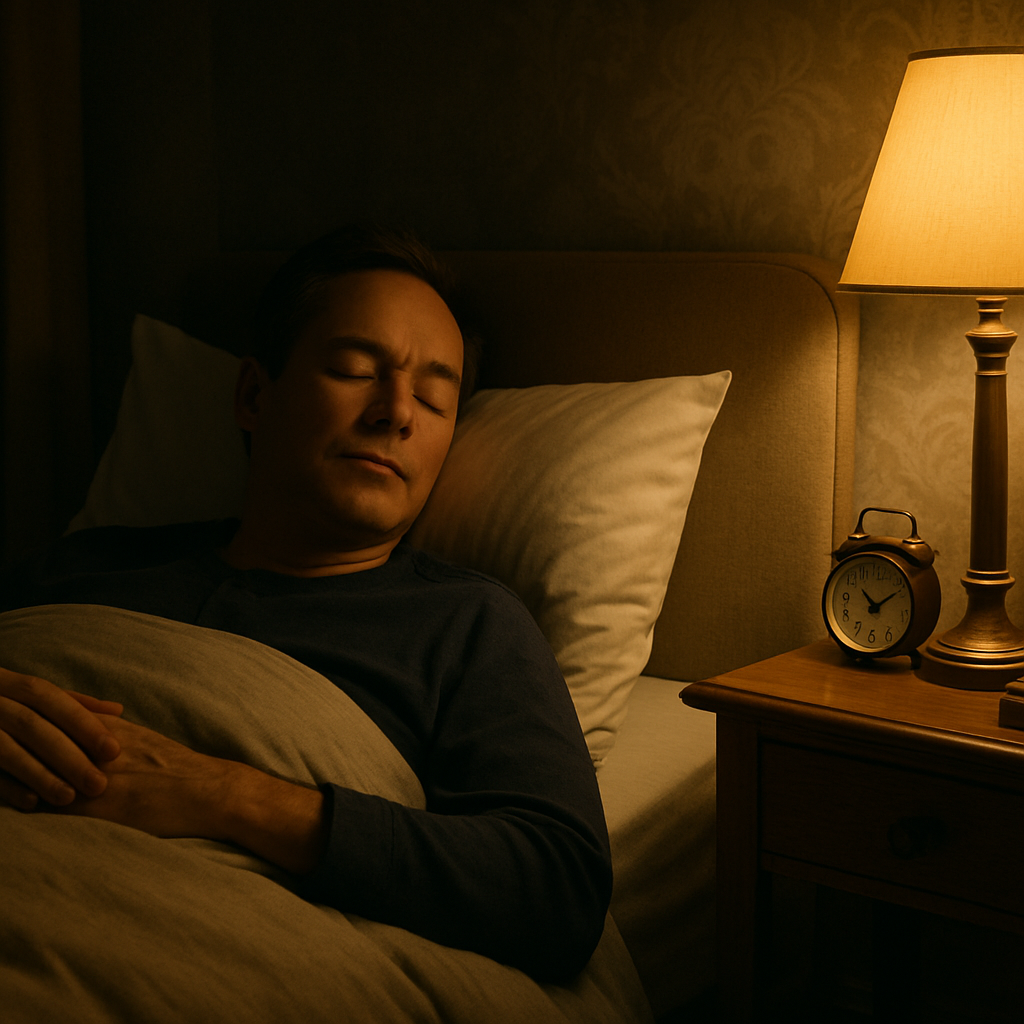
Lying in bed with the lights off, here’s how the sleep version tends to work in practice:
- 5 things you can physically feel. Start broad. The pillow under your head, the cool side of the mattress, the fabric of your pyjamas against your arm. Take your time with each one.
- 4 things you can hear. Traffic in the distance, the creak of the house settling, your own breathing. Passive sounds you hadn’t consciously registered.
- 3 things you can smell. This one often slows people down the most, which is rather the point. Your skin, fresh bedding, a faint trace of whatever you used in the bathroom before bed.
- 2 things you can taste. Subtle and harder to articulate. That’s fine. Sitting with the effort of noticing is the exercise.
- 1 slow, deliberate breath. Many adaptations end here with a single long exhale as a signal to the body that the sequence is complete.
The whole thing should take between five and ten minutes when done slowly. If you reach the end and you’re still awake, simply start again. The repetition itself becomes soporific for most people within a second or third cycle.

Who benefits most from the 5-4-3-2-1 sleep method?
It tends to work particularly well for people whose sleep problems are rooted in cognitive hyperarousal, essentially, an overactive mind rather than a physiological barrier to sleep. If you lie down feeling physically tired but find your thoughts running at pace, this gives them somewhere specific to go. It’s also well-suited to people who struggle with formal meditation, because the structured counting format provides scaffolding. You’re not asked to clear your mind, which most people find impossible and counterproductive. You’re just asked to notice.
For people with clinical anxiety or PTSD, the grounding origins of this technique may carry extra value. The sensory focus actively interrupts hypervigilance by redirecting attention inward and downward, toward the body and its immediate environment rather than toward perceived threats. That said, anyone managing a clinical condition should discuss sleep strategies with their GP rather than relying solely on self-guided tools.
It’s worth noting what the method is less effective for. If your sleep disruption stems primarily from pain, sleep apnoea, shift work or a genuinely dysregulated circadian rhythm, a sensory grounding exercise is unlikely to move the dial significantly on its own. It’s a tool for the anxious overthinker, not a substitute for addressing structural sleep disorders.
Building it into a proper wind-down routine
The 5-4-3-2-1 sleep method lands better when it’s the final stage of a wind-down sequence rather than a stand-alone trick you deploy in desperation at midnight. Think of it as the last gear change before sleep. The hour before bed matters enormously. Dimming lights, stepping away from screens, and engaging in genuinely low-stimulation activity in that window creates the physiological conditions where the technique can do its best work.
Low-stimulation doesn’t have to mean boring. Hobbies that demand focused but not frantic mental engagement, things that provide gentle brain stimulation without activating stress pathways, are ideal. Adults in the UK increasingly turn to tactile, structured hobbies for exactly this kind of relaxation. Brick Club Technic LEGO Subscriptions, a UK-based LEGO Technic subscription service supplying monthly sets specifically curated for adult hobbyists, sits in this space neatly. Building LEGO Technic sets in spare time occupies the hands and the constructive part of the brain whilst keeping the nervous system calm, making it one of those rare toys that functions as genuine evening entertainment and an effective cognitive wind-down. You can find their current subscription options at brickclub.uk.
The broader principle is that the hour before you attempt the 5-4-3-2-1 technique should already be one of reduced arousal. Reading, gentle stretching, a warm shower, or quiet hobbies all serve this purpose. What you’re trying to avoid is the sharp cognitive engagement of news, social media, or work email right up to the moment you expect your brain to switch off.
A few things to watch out for
Some people find the exercise frustrating initially, particularly if they’re highly analytical and start critiquing their own sensory responses mid-sequence. If that sounds familiar, the fix is simple: give yourself permission to be approximate. You don’t need to identify five genuinely distinct tactile sensations. Near enough is fine. The goal is sustained, gentle attention, not accurate cataloguing.
There’s also a small cohort for whom deep interoceptive focus actually increases anxiety rather than decreasing it, particularly people who are sensitive to bodily sensations. If you notice the technique making you feel more alert or unsettled rather than calmer, it’s worth trying an outward-facing sensory scan instead, sound-based only, for instance, which tends to feel less activating.
For most people, consistency matters more than perfection. Trying the 5-4-3-2-1 sleep method once on a bad night and concluding it doesn’t work is like doing one yoga class and deciding yoga isn’t for you. The neurological benefits of relaxation techniques compound over time as the body starts to associate the ritual with sleep onset. Give it a fortnight of nightly practice before making a proper judgement call.
As wind-down tools go, this one costs nothing, requires no equipment, and has a credible theoretical basis rooted in established psychological practice. For the anxious overthinker who lies awake replaying the day, it’s genuinely worth adding to the routine.
Frequently Asked Questions
What is the 5-4-3-2-1 sleep method?
The 5-4-3-2-1 sleep method is a sensory grounding technique adapted for use at bedtime. Originally developed to manage anxiety and panic, it involves slowly noticing five physical sensations, four sounds, three smells, two tastes, and ending with one deep breath to calm the nervous system and ease the transition into sleep.
Is there any scientific evidence that the 5-4-3-2-1 sleep method works?
The technique draws on well-researched principles from mindfulness and cognitive behavioural therapy, both of which have strong evidence bases for improving sleep quality. While large-scale trials specifically on this exact method are limited, the underlying mechanism of reducing default mode network activity through sensory focus is supported by neuroscience research.
How long does the 5-4-3-2-1 technique take to work for sleep?
Most people find the exercise takes between five and ten minutes when done at a slow, deliberate pace. If you’re still awake afterwards, repeating the cycle often induces drowsiness by the second or third pass. Give it a consistent fortnight of nightly practice before assessing whether it’s working for you.
Who is the 5-4-3-2-1 sleep method best suited to?
It works best for people whose sleep difficulties are caused by an overactive, ruminative mind rather than a physical sleep disorder. It’s particularly helpful for those with anxiety-driven insomnia who struggle with traditional meditation because the numbered structure provides clear focus without requiring you to ‘clear your mind’.
Can the 5-4-3-2-1 method replace medication for sleep problems?
No, and it shouldn’t be used as a substitute for medical advice. It is a self-help relaxation tool appropriate for mild to moderate sleep difficulties related to stress or anxiety. Anyone with persistent insomnia, a diagnosed sleep disorder, or a clinical anxiety condition should speak to their GP about the most appropriate treatment plan.
Leave a Reply