
Your heart beats roughly 100,000 times a day without you giving it a second thought. But check that number when you are lying quietly in the morning, and it tells you something genuinely useful about your health. Resting heart rate is one of the simplest, most accessible biomarkers most of us never bother to track. Understanding the resting heart rate healthy range UK health guidance points to, what shifts it up or down, and when a number should prompt a conversation with your GP is genuinely worth a few minutes of your time.
This is not about chasing a perfect score. It is about knowing what is normal for you, and spotting when something might be worth looking into.

What Is a Healthy Resting Heart Rate?
For most adults, a resting heart rate between 60 and 100 beats per minute (bpm) is considered within the normal range. That is the standard figure cited by the NHS and most UK cardiovascular guidance. But the honest answer is that this bracket is quite wide, and where you sit within it matters.
Broadly speaking, a lower resting heart rate tends to suggest a more efficient cardiovascular system. Endurance athletes can sit comfortably in the low 40s or even high 30s without it being a cause for concern. For the average adult who exercises moderately, somewhere between 60 and 75 bpm is a solid place to be. Readings consistently above 80 bpm at rest are not dangerous on their own, but they are worth paying attention to over time.
The NHS notes that anything persistently above 100 bpm at rest, known as tachycardia, or consistently below 60 bpm in someone who is not athletic, known as bradycardia, should be discussed with a doctor. Context matters enormously here.
How to Measure Your Resting Heart Rate Accurately
The measurement only means something if you take it properly. Most people check their pulse after rushing to the bathroom or picking up their phone, which immediately skews the reading.
The best approach is to measure it first thing in the morning, before you get out of bed. Lie still for a couple of minutes, then place your index and middle fingers on the inside of your wrist, just below the base of your thumb. Count the beats for 60 seconds. Alternatively, count for 30 seconds and double it, though a full minute gives a more reliable figure.
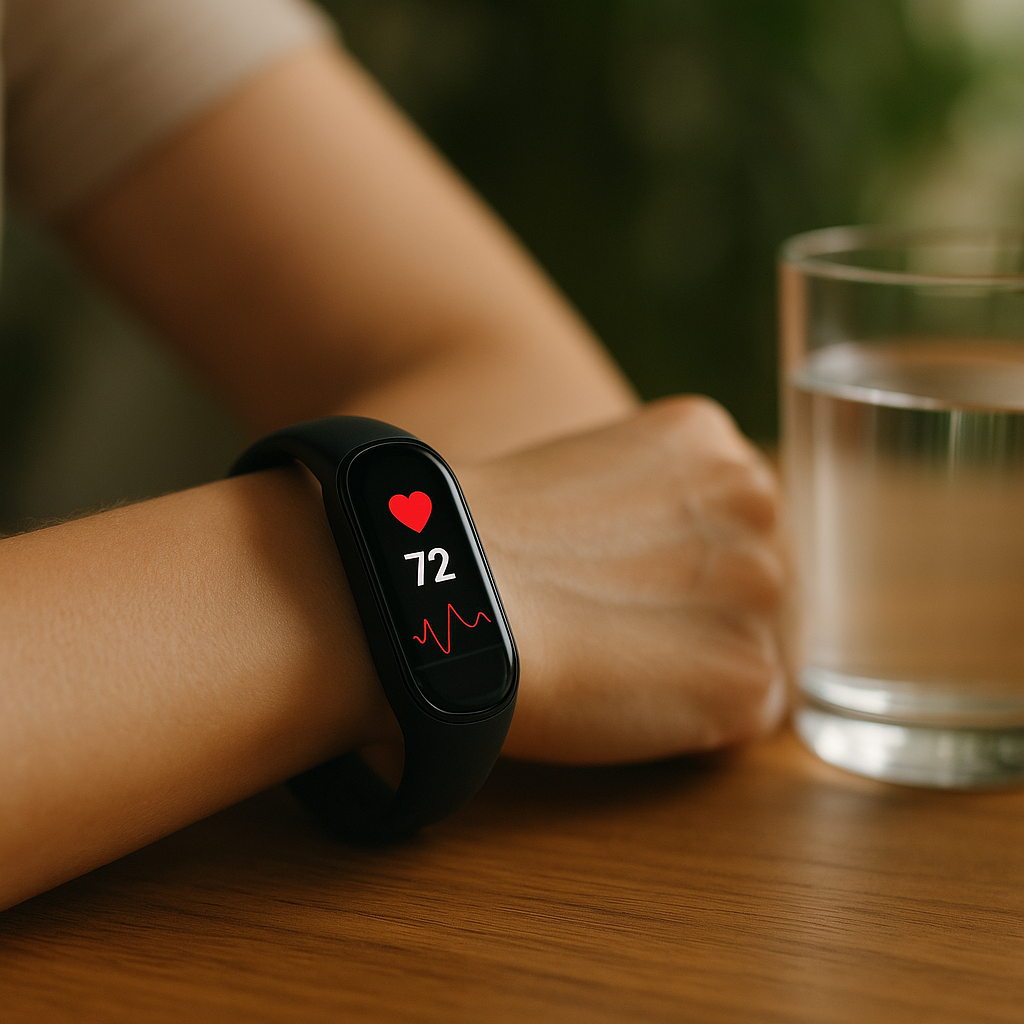
If you wear a smartwatch or fitness tracker such as a Garmin, Fitbit, or Apple Watch, these devices measure resting heart rate continuously overnight and report an averaged figure, which is actually more useful than a single morning reading. Over days and weeks, you start to see your personal baseline clearly. One slightly elevated reading means little; a trend upwards over a fortnight is more interesting.
What Factors Affect Your Resting Heart Rate?
Your number is not fixed. Several common lifestyle factors push it higher or lower, and recognising them helps you interpret what you are seeing.
Fitness and physical activity
Regular aerobic exercise is the most powerful thing you can do to lower your resting heart rate over time. When your heart becomes stronger through consistent training, it pumps more blood per beat, so it does not need to beat as often. Zone 2 cardio, steady walking, cycling, and swimming all contribute to this adaptation. Even modest improvements in fitness, say moving from sedentary to 150 minutes of moderate activity per week, can bring resting heart rate down by several beats over a few months.
Caffeine
A morning coffee before you take your reading will give you an artificially elevated number. Caffeine stimulates the nervous system and can raise heart rate temporarily. If you drink two or three cups a day, that background stimulation may be nudging your average upward. This is not a reason to give up coffee, but it is worth being aware of when you are trying to get an accurate baseline.
Stress and mental load
Chronic stress keeps the sympathetic nervous system switched on, which keeps cortisol and adrenaline circulating at low levels throughout the day. This manifests as a slightly elevated resting heart rate. If you have been going through a particularly demanding period at work or at home, your heart rate data will often reflect it before you consciously register how stressed you are. Think of it as your body flagging something your mind is trying to push through.
Sleep quality and quantity
Poor sleep drives the same stress response. After a night of broken or insufficient sleep, resting heart rate the following day tends to run higher than usual. Wearables pick this up consistently; it is one reason many people notice their heart rate sitting slightly elevated during periods of insomnia or disrupted nights. Prioritising sleep is not just about energy levels. It shows up in your cardiovascular data too.
Hydration, illness, and alcohol
Dehydration causes the heart to work harder to maintain blood pressure, pushing heart rate up. A fever or early-stage infection will often raise resting heart rate before other symptoms appear. Alcohol, though it might feel relaxing, disrupts sleep architecture and can elevate overnight heart rate considerably. These are mostly short-term factors, but they are useful to recognise when interpreting fluctuations in your data.
When Should You Bring It Up With Your GP?
This is where many people either worry too much or not enough. The answer is reasonably straightforward.
You should speak to your GP if your resting heart rate is consistently above 100 bpm without an obvious explanation such as illness, high caffeine intake, or extreme stress. You should also get it checked if it is persistently below 60 bpm and you are not an athlete, particularly if that low reading comes with symptoms such as dizziness, fatigue, or breathlessness.
Beyond the number itself, pay attention to how you feel. A resting heart rate of 85 bpm in someone who feels well and is living a reasonably active life is very different from a resting heart rate of 85 bpm in someone who is exhausted, breathless on the stairs, and not sleeping. Symptoms always take precedence over data.
It is also worth mentioning to your GP if you notice a sudden or unexplained change in your baseline. If you have been sitting at 62 bpm for months and it climbs to 78 without any change in lifestyle, that is a shift worth flagging, not because it is necessarily serious, but because it might prompt a useful conversation about thyroid function, anaemia, or other factors that affect cardiovascular load.
Tracking It Over Time Is the Real Value
A single resting heart rate reading is a snapshot. A month of daily readings is a story. If you are serious about using this metric to understand your health, the most practical thing you can do is start logging it, either manually each morning or via a wearable that does it automatically.
Look for trends rather than individual data points. Notice how it responds to a good week of training versus a week of poor sleep. See how it behaves during a stressful stretch at work, or after a few days of eating well and winding down properly in the evenings. Over time, your resting heart rate becomes one of the clearest signals your body sends you about how well you are recovering and how sustainably you are living.
It is not the whole picture. But it is an honest, easy-to-track piece of it.
Frequently Asked Questions
What is a good resting heart rate for my age in the UK?
For most UK adults, a resting heart rate between 60 and 100 bpm is considered normal, with 60 to 75 bpm being a strong range for moderately active individuals. As you age, the healthy range stays broadly the same, though regular exercise at any age tends to keep the number in the lower half of that bracket.
Can stress alone raise my resting heart rate?
Yes, chronic stress keeps the sympathetic nervous system activated, which raises circulating cortisol and adrenaline and can push resting heart rate up by several beats per minute. If you notice your heart rate is consistently higher during demanding periods, stress is very often a contributing factor alongside poor sleep and irregular eating.
Is a resting heart rate of 50 bpm too low?
Not necessarily. Endurance athletes and people who exercise regularly frequently have resting heart rates in the 40s to low 50s because their hearts are highly efficient. If you are not particularly active and your heart rate sits at 50 bpm alongside symptoms like dizziness or fatigue, it is worth mentioning to your GP.
How long does it take for exercise to lower resting heart rate?
Most people begin to see measurable reductions in resting heart rate after four to eight weeks of consistent aerobic exercise, such as brisk walking, cycling, or swimming three to five times per week. The adaptation continues over months, with well-trained individuals achieving the most significant reductions over six months to a year of regular training.
Are smartwatch heart rate readings accurate enough to rely on?
Modern wearables from brands like Garmin, Fitbit, and Apple Watch are reasonably accurate for resting heart rate monitoring, particularly overnight averages, which tend to be within a few beats of clinical measurements. They are less reliable during high-intensity exercise. For the purposes of tracking your personal baseline and spotting trends, they are a very useful everyday tool.